Organisation
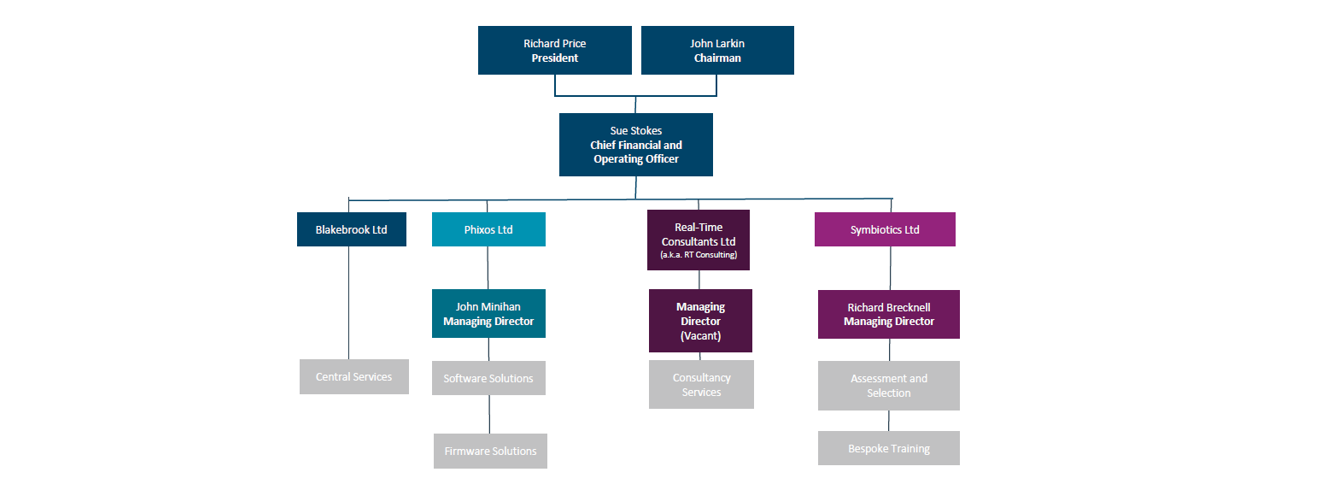
In this document, all references to Blakebrook refer to Blakebrook Limited and its subsidiaries; Phixos Limited, Symbiotics Limited, and Real-Time Consultants Limited, and to include its trading division RT Consulting.
The information included in the statement refers to the Financial Year 2025
Organisational Structure
Definitions
Blakebrook considers that modern slavery encompasses:
- Human trafficking;
- Forced work, through mental or physical threat;
- Being owned or controlled by an employer through mental or physical abuse of the threat of abuse;
- Being dehumanised, treated as a commodity or being bought or sold as property;
- Being physically constrained or to have restriction placed on freedom of movement.
Commitment
We acknowledge our responsibility to help prevent modern slavery and human trafficking and are committed to complying with the provisions in the Modern Slavery Act 2015. We understand that this requires an ongoing review of our employment practices, policies and procedures, as well as appropriate due diligence within our supply chains.
We are committed to conducting business only with organisations that share our commitment to ethical working practices and the prevention of modern slavery. We undertake proportionate due diligence of our suppliers and business partners to help identify, prevent and address potential modern slavery risks within our operations and supply chains.
We are committed to ensuring that no form of slavery, servitude, forced or compulsory labour, or human trafficking occurs within our business. We comply with all applicable UK employment legislation and maintain fair employment practices that support the welfare, dignity and rights of our employees. Where appropriate, we seek to exceed minimum legal requirements and promote high standards of employment and workplace conduct.
Potential Exposure
We recognise that the risk of modern slavery can exist in all sectors and supply chains. Given the nature of our business and workforce, we consider the risk of modern slavery within our direct business activities to be relatively low.
However, we acknowledge that risks may arise within our wider supply chains and therefore remain committed to identifying, assessing and addressing potential areas of concern.
To mitigate these risks, we maintain appropriate policies and procedures designed to promote ethical business practices and help prevent modern slavery and human trafficking within our operations and supply chains.
Steps
We undertake due diligence to help identify, assess and mitigate the risk of modern slavery and human trafficking within our operations and supply chains. This includes reviewing suppliers and business partners as part of our procurement and onboarding processes, assessing potential risk factors where appropriate, and ensuring that suppliers are expected to comply with applicable legal and ethical standards.
We are committed to maintaining effective policies, contractual controls and reporting mechanisms that support the prevention and detection of modern slavery and human trafficking. Employees are encouraged to raise any concerns through our whistleblowing procedure, while concerns raised by suppliers or other stakeholders will be considered and addressed through appropriate channels.
We are not aware of any confirmed incidents of modern slavery or human trafficking within our operations or supply chain during the reporting period.
In accordance with Section 54(4) of the Modern Slavery Act 2015, we have implemented the following measures to help prevent modern slavery and human trafficking within our operations and supply chains:
- Providing a whistleblowing procedure that enables employees to raise concerns relating to modern slavery, human trafficking or unethical working practices.
- Undertaking appropriate pre-employment checks, including verifying employees’ right to work in the UK, and maintaining payroll processes to ensure employees are paid in accordance with applicable employment legislation and National Minimum Wage requirements.
- Seeking to ensure that appropriate contractual provisions are included in relevant supplier and commercial agreements, requiring suppliers and contractors to comply with applicable modern slavery legislation and to maintain appropriate standards within their own supply chains.
- Identifying and assessing potential areas of risk within our supply chains and taking appropriate action where concerns are identified.
- Considering modern slavery risks as part of our wider approach to corporate responsibility, ethical business practices and supplier management.
Training
We are committed to raising awareness of modern slavery and human trafficking across the organisation. Employees receive training on modern slavery, ethical working practices and whistleblowing arrangements as part of our induction programme, with annual refresher training provided to maintain awareness of potential risks, reporting mechanisms and individual responsibilities
Modern Slavery Governance
We have appointed a designated Modern Slavery Compliance Officer with responsibility for overseeing our approach to preventing modern slavery and human trafficking. Any concerns relating to modern slavery, human trafficking or unethical labour practices should be reported through the appropriate internal channels, including our whistleblowing procedure, and will be reviewed and addressed in accordance with our policies and legal obligations.
This statement is made pursuant to Section 54(1) of the Modern Slavery Act 2015 and sets out the steps we have taken to help prevent modern slavery and human trafficking within our business and supply chains during the relevant financial year.
We will review this statement annually and update it as necessary to reflect changes in our business, supply chains and legal obligations.
Sue Stokes
Chief Financial and Operating Officer
Date: 28th October 2026